

Sidebar: What Do Mormons Actually Believe?
Get ready for some definitional bait-and-switches.

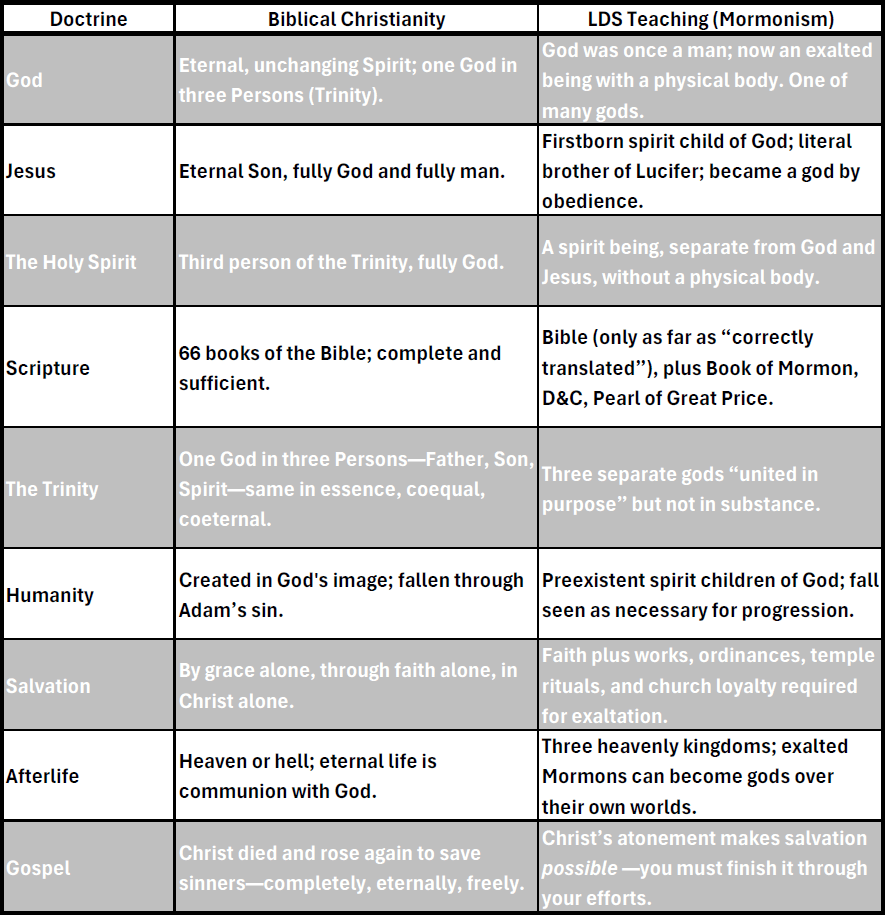
This is a companion piece for our paid article, Burning Bosoms and Broken Promises. The Church of Jesus Christ of Latter-day Saints (LDS)—also called the Mormon Church—uses a lot of Christian language. But don’t be fooled: the theological meanings behind those words are radically different. Here’s a quick rundown of their core doctrines, compared with biblical Christianity:
God
LDS: God the Father (“Heavenly Father”) was once a man who lived on another planet. He progressed to godhood and now has a physical body of flesh and bones. He is one of many gods.
Biblical Christianity: God is eternally God—unchanging, uncreated, and utterly unique (Isa. 43:10; Ps. 90:2). He is Spirit (John 4:24), not an exalted man.
Jesus Christ
LDS: Jesus is the literal firstborn spirit child of Heavenly Father and one of His heavenly wives. He is the older brother of Lucifer.
Biblical Christianity: Jesus is the eternal Son, the second person of the Trinity, fully God and fully man (John 1:1–14; Col. 1:15–20). He is not created and certainly not Satan’s sibling.
Scripture
LDS: Four authoritative books: the Bible (only “insofar as it is correctly translated”), the Book of Mormon, Doctrine & Covenants, and the Pearl of Great Price.
Biblical Christianity: The 66 books of the Old and New Testaments are the complete, inspired, inerrant Word of God (2 Tim. 3:16–17). No additions needed—or allowed (Rev. 22:18–19).
The Trinity
LDS: Rejects the historic doctrine of the Trinity. God the Father, Jesus Christ, and the Holy Ghost are “three separate beings” united in purpose but not essence.
Biblical Christianity: One God in three coequal, coeternal persons—Father, Son, and Spirit (Matt. 28:19; Deut. 6:4; John 10:30).
Humanity and the Fall
LDS: Humans are literal spirit children of God, sent to earth to get physical bodies and prove themselves. Adam’s fall was necessary and ultimately good—it enabled humanity to progress.
Biblical Christianity: Humanity is made in God’s image (Gen. 1:27) but fell into sin through Adam (Rom. 5:12). The Fall was tragic, not a “fortunate step forward.”
Salvation
LDS: Faith in Christ is just the beginning. Full “exaltation” (godhood) requires baptism, temple ordinances, obedience to church leadership, and good works.
Biblical Christianity: Salvation is by grace alone, through faith alone, in Christ alone—not of works (Eph. 2:8–9; Gal. 2:16).
Eternal Life
LDS: The faithful can become gods, ruling over their own planets with their eternal spouse. Those who are less faithful may go to lower tiers of heaven.
Biblical Christianity: Eternal life is communion with God, not competition to replace Him (John 17:3; Rev. 21:3–4). There is one heaven and one hell—no tiers, no planets.
Bottom Line
Mormonism doesn’t restore the gospel. It replaces it—with a polytheistic system, a works-based ladder to divinity, and a false Christ who cannot save.
Summary
A Final Word
Here’s the bottom line: Mormonism doesn’t just tweak a few doctrines. It tells a different story about God, a different identity for Jesus, and a different path to salvation altogether. It swaps grace for works, Scripture for feelings, and the eternal God for a glorified man from Kolob.
And it cannot save you.
You don’t need another testimony meeting. You don’t need a spiritual burning. You don’t need a temple recommend or a secret name whispered in the right room.
You need Christ. The real Christ.
Not your elder brother. Not your example in becoming divine. Not a spiritual stepping-stone to your own planet.
You need the eternal Son of God—crucified for your sins, raised in glory, and reigning in power.
You need His finished work. His righteousness. His mercy.
And you need it not because of how you feel—but because of who He is.
Come to Him. The gospel is better than the warm feeling you’ve been chasing. It’s solid ground. It’s good news. It’s done.
P.S.
Next week, we’re shaking a few more sacred cows.
Wednesday: “If You Find a Perfect Church, Leave Before You Mess It Up.”
Friday: “The Reformation Was an Accident”—or was it?